
History: the 16-bit generation
The Super Famicom launched in Japan in 1990. Its overseas counterpart, the Super Nintendo Entertainment System, followed in North America in 1991 and Europe in 1992. It succeeded the NES while keeping cartridge-based games and a strong focus on Nintendo’s established series. The platform’s catalogue grew through platformers, racing games, fighting games and role-playing adventures. SNES, Super NES and Super Famicom describe closely related regional systems, not identical packaging and hardware in every market.
Hardware and the controller
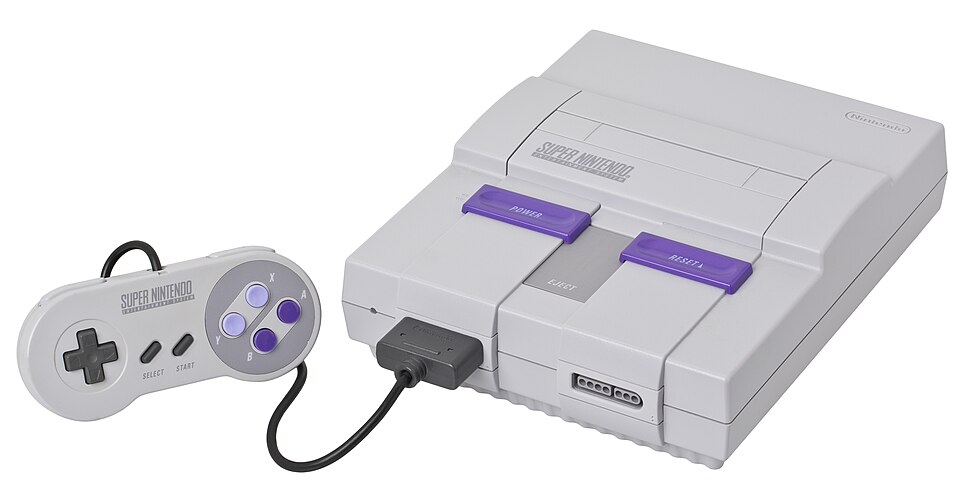
The 16-bit SNES controller combines a directional pad with four face buttons, Start, Select and two shoulder buttons. That layout supports more actions without abandoning the familiar pad. Games such as Super Mario Kart show how rotation and scaling effects could shape play, while other titles emphasise detailed sprite animation. A console’s headline bit count does not explain every game: cartridges and software techniques also matter. The system uses analogue television connections rather than native HDMI.
Regional shapes and revisions
The European SNES resembles the Japanese Super Famicom, with a rounded shell and coloured controller buttons. The North American model has a more angular case and purple accents; that is the version pictured here. Later compact hardware revisions exist, and their video outputs can differ. Identify the actual model before choosing cables or a power supply. The SNES Classic Edition is a later miniature with a fixed built-in library and does not accept original SNES cartridges.
A library beyond one genre
The games below are editorial entry points, not a ranking of rarity. Platforming, overhead adventure, exploration and racing offer different reasons to return to the machine. Original manuals can clarify unfamiliar mechanics without spoiling an entire game. When collecting imports, confirm language support and regional behaviour, particularly for text-heavy adventures. A modern remaster, a digital rerelease and an original cartridge can differ in presentation and features, so record them as distinct editions.
Super Mario World
Explore a platform adventure built around Yoshi and branching routes.
Open my collection ↗The Legend of Zelda: A Link to the Past
A substantial overhead adventure with a world worth mapping.
Open my collection ↗Cartridges and Super Game Boy
A SNES does not natively play NES cartridges. Regional cartridge shapes, lockout systems and PAL/NTSC differences also mean imported SNES games require individual compatibility checks. The Super Game Boy accessory offers a different kind of compatibility: playing supported Game Boy cartridges through the television. It does not make every Game Boy Color or Game Boy Advance game compatible. Check Nintendo’s cartridge guide and the accessory’s requirements before buying a mixed collection.
Playing on original and modern hardware
Original cartridges do not rely on an online storefront to start. On a modern television, a suitable converter or scaler can help connect the analogue signal, but picture quality and delay depend on the setup. Selected SNES games are also available through Nintendo’s modern classic libraries. Check the current selection and membership requirements separately from the original hardware. For local multiplayer on the SNES itself, start by confirming the game’s controller and player requirements.
Inspecting and preserving a SNES
Test sound, video, both controller ports and several cartridges. A yellowed shell is a condition detail, not by itself proof of an electronic fault; a bright replacement shell is not proof of originality either. Ask about repairs, modifications and cartridge batteries. Some save batteries can fail after decades, so test saving and protect important saves before maintenance. Keep a record of console region, model, cables, box and manuals. Use the correct power supply for that exact regional model.
Sources and editorial notes
An independent guide with manufacturer references. Buying choices and inspection checklists are editorial guidance. Services can change; consult current support notices.